Repair approaches
Robotic-assisted hernia repair
A minimally invasive option using the da Vinci platform, when it is appropriate for your hernia and your health. The surgeon, not the robot, performs the operation.
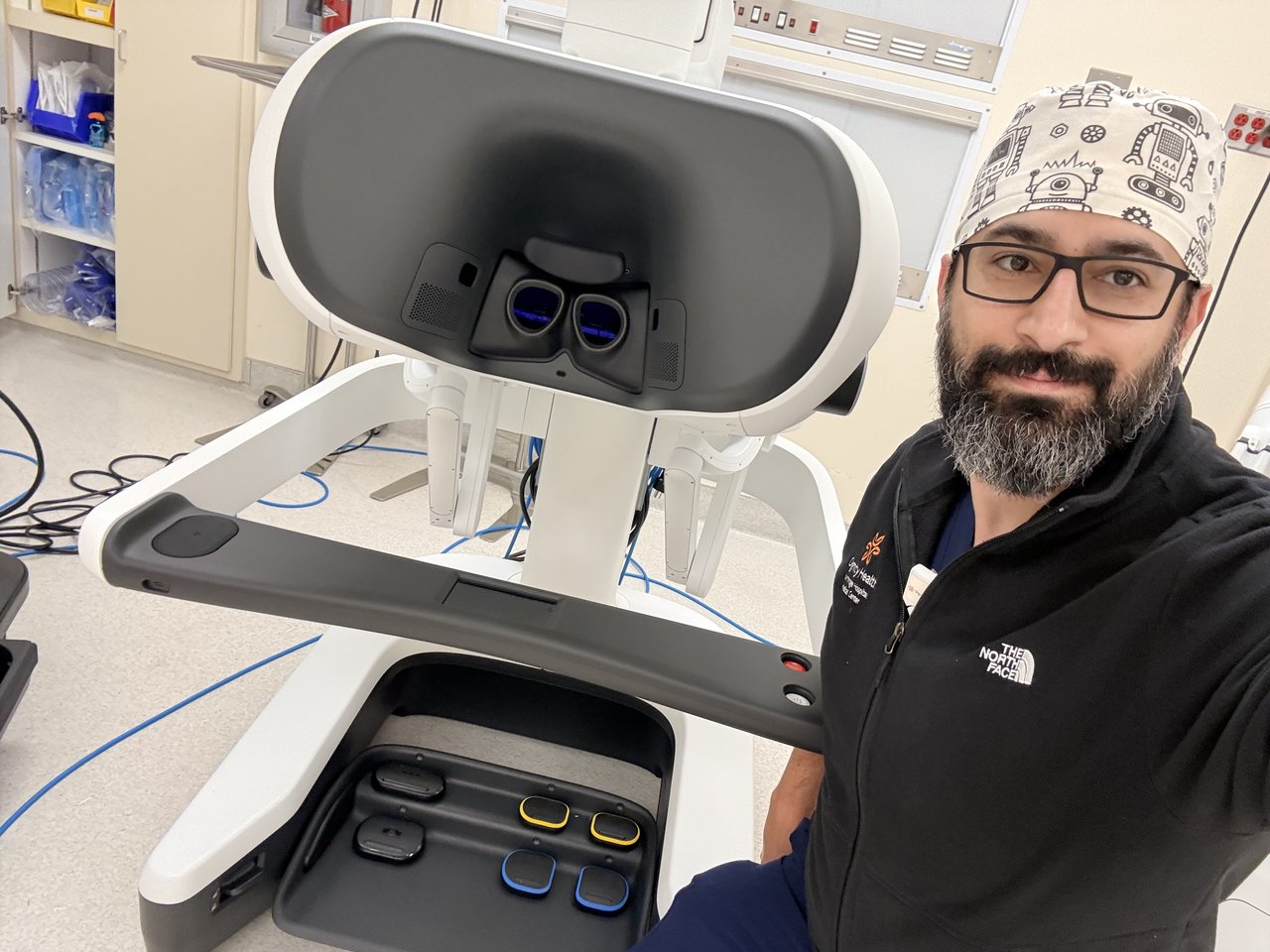
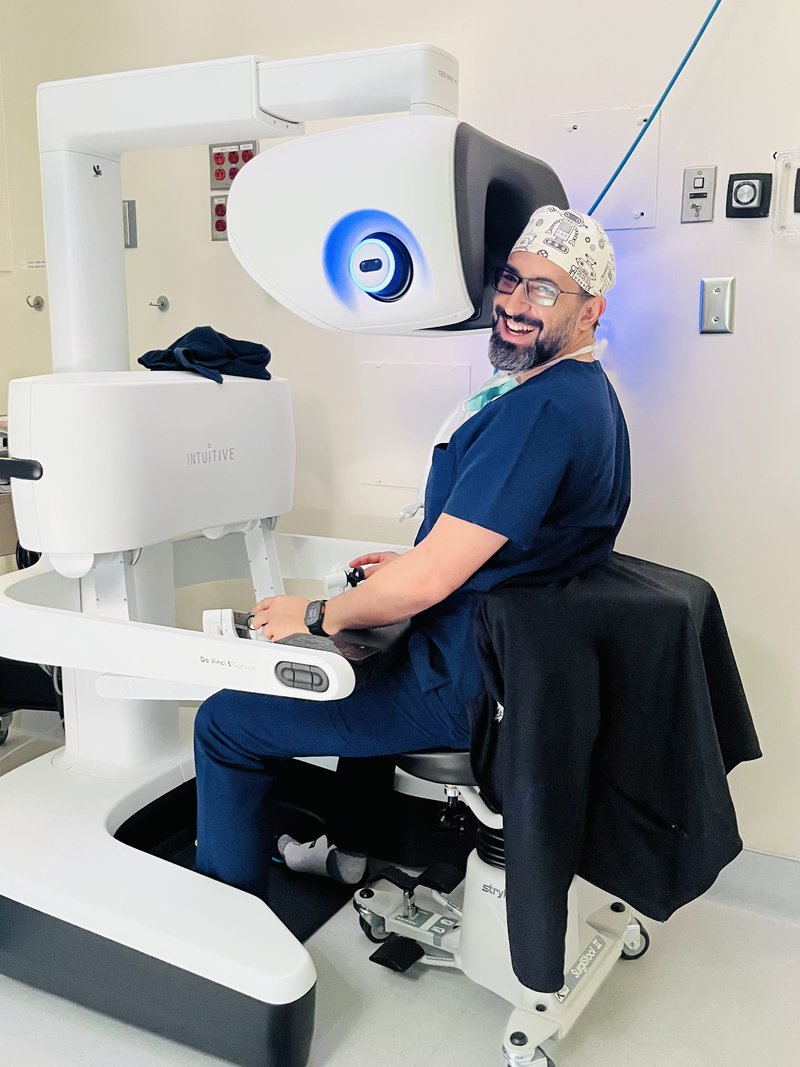
The da Vinci system
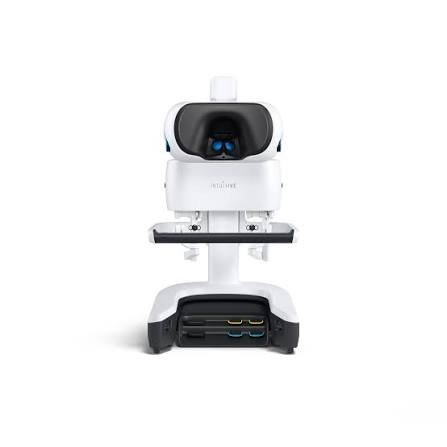
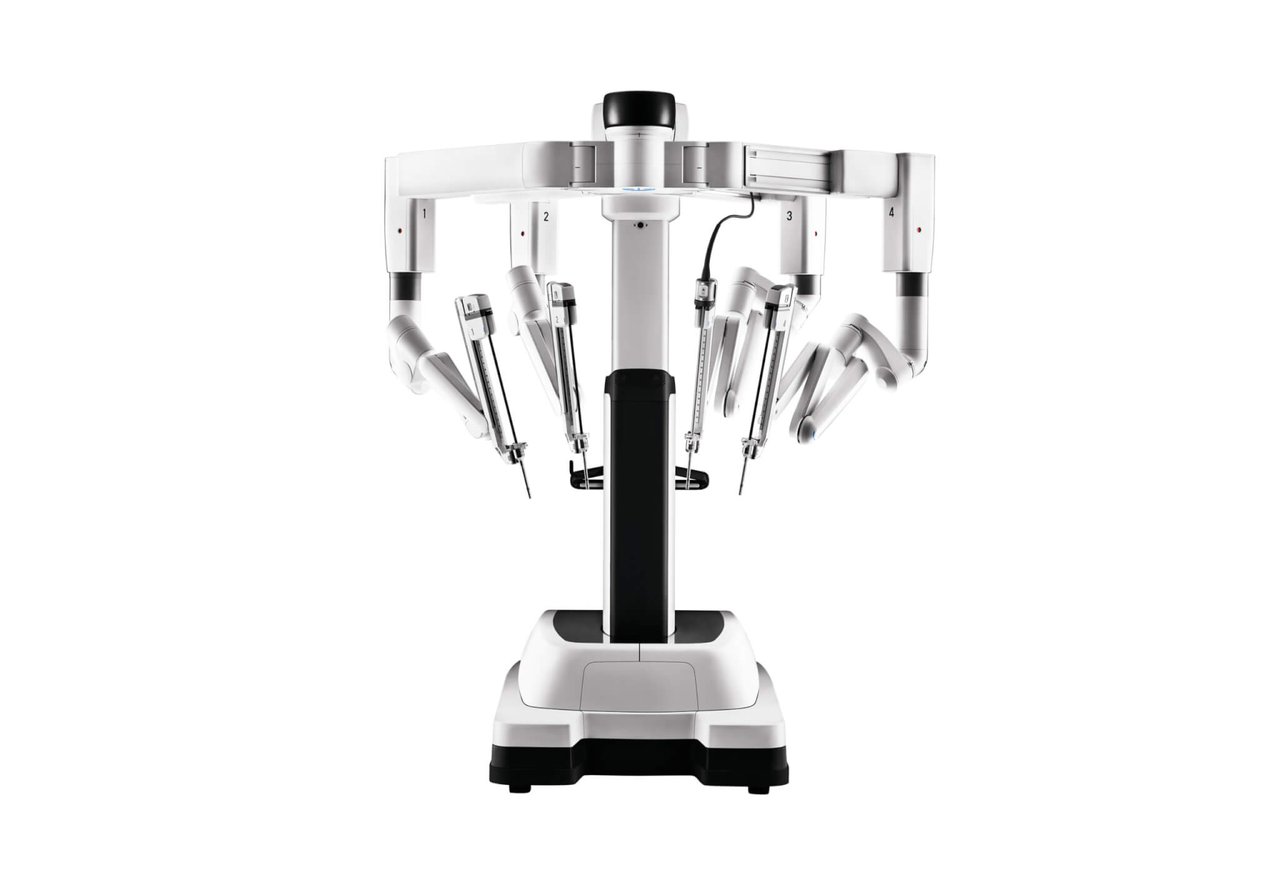
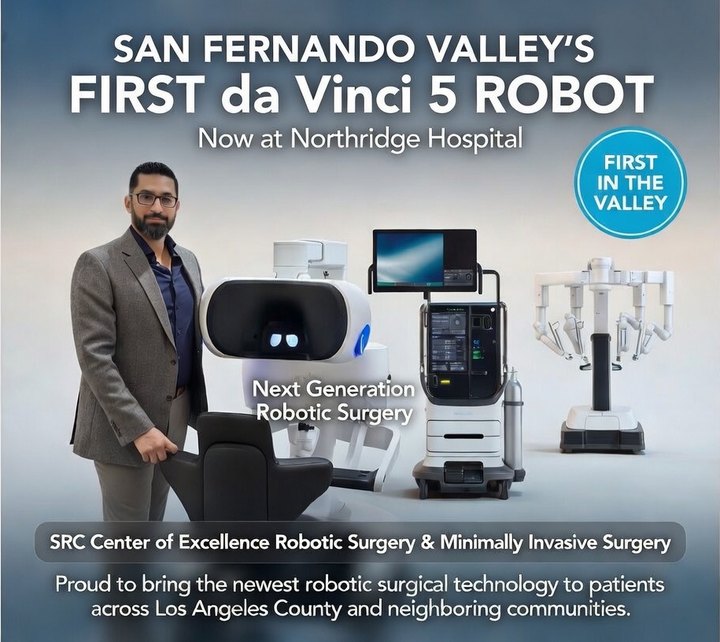
Robot-assisted cases in this practice are performed on the da Vinci platform (Intuitive) when that approach is appropriate. The system includes a surgeon console and a patient-side cart. The surgeon controls the instruments; the robot does not operate on its own. The San Fernando Valley's first da Vinci 5 robot is now at Northridge Hospital.
- What robotic-assisted hernia repair is
- Who may be a candidate
- What to expect
- Recovery: typical ranges
- Where the mesh goes
- Care with Dr. Toomari
- Surgical images
- Surgical videos
- Questions patients often ask
- Related pages
What robotic-assisted hernia repair is
Robotic-assisted hernia repair is a minimally invasive operation. Several small incisions are used. The surgeon sits at a console and controls wristed instruments and a camera, which provide a magnified view of the abdominal wall. In this practice, those cases are performed on the da Vinci platform (Intuitive) when that approach is appropriate.
Dr. Toomari is a board-certified general surgeon (American Osteopathic Board of Surgery) specializing in robotic surgery. He has over 13 years of surgical experience and has been in private practice in Encino since 2014. He has performed more than 2,200 robotic procedures and is one of the highest-volume robotic surgeons in the San Fernando Valley. He is Director of Robotic Surgery at Dignity Health – Northridge Hospital Medical Center. His individual SRC designations are Robotic Surgeon of Excellence (SRC) and Minimally Invasive Surgery (MIS) Surgeon of Excellence (SRC). Separately, Northridge Hospital Medical Center, where Dr. Toomari is Director of Robotic Surgery, is designated an SRC Center of Excellence in Robotic Surgery and Minimally Invasive Surgery. That is a hospital designation, not an individual credential. He was the first in the San Fernando Valley to perform da Vinci Xi robotic paraesophageal (hiatal) hernia repairs. The San Fernando Valley's first da Vinci 5 robot is now at Northridge Hospital. Volume is not a promise of a particular result for any one patient. Hernia case counts and console times from his Intuitive system records are in Experience by the numbers, below.

Who may be a candidate
Candidacy depends on the type and size of the hernia, prior abdominal or prostate surgery, and your overall health. Some patients who are not good candidates for standard laparoscopy may still be considered for a robotic repair. Only an exam can determine whether it is a fit.
What to expect
The operation is done under general anesthesia. Many groin and smaller ventral repairs are planned as outpatient or short-stay procedures. Afterward you will have small incisions, a plan for pain control and clear limits on lifting. Open conversion is uncommon but is used if the surgeon judges it is safer in the moment.
Recovery: typical ranges
Robotic-assisted repair may offer a quicker return to activities and less pain for some patients. It is not the right choice for everyone, and it is not a guarantee. Many people walk the same day and return to light activity within several days to about two weeks, with heavy lifting typically limited for 8 weeks (no lifting over 10 lb) (sometimes longer after a larger ventral repair or reconstruction).
These are typical ranges only. Recovery varies with the hernia, the type of repair, your health and the work or activity you return to. Dr. Toomari will advise you on walking, lifting, driving and follow-up for your situation.
Where the mesh goes
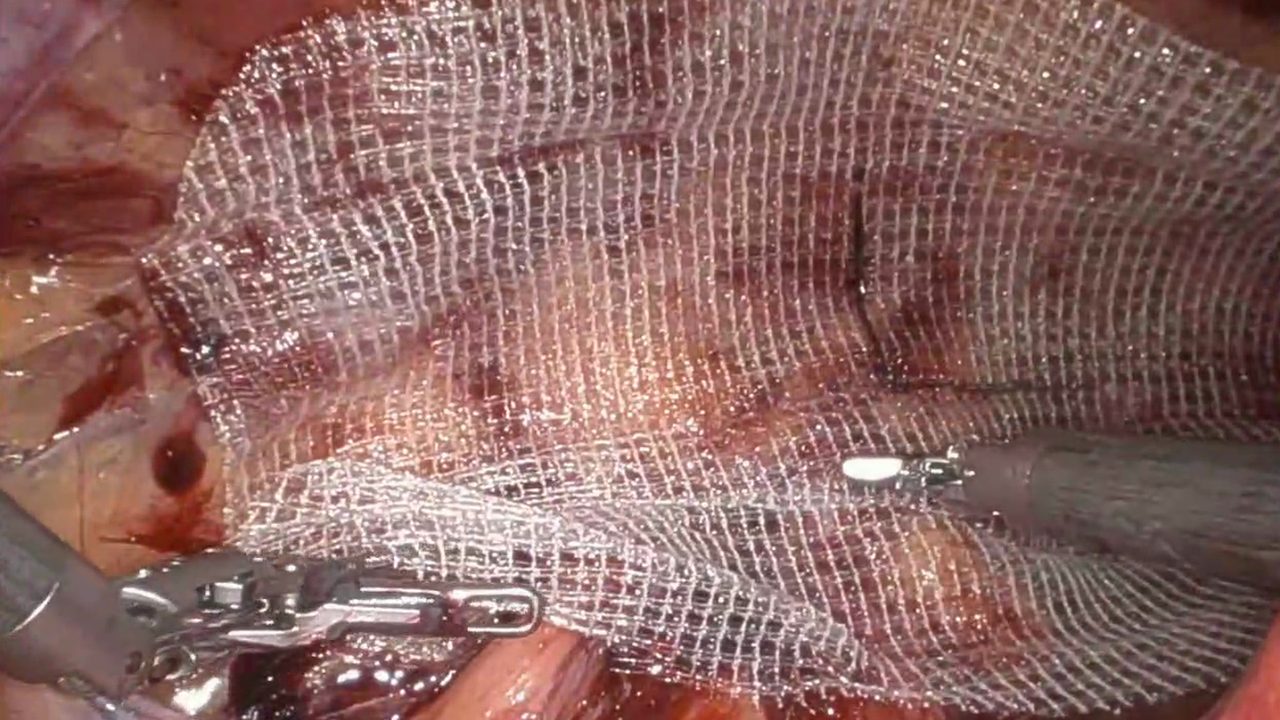
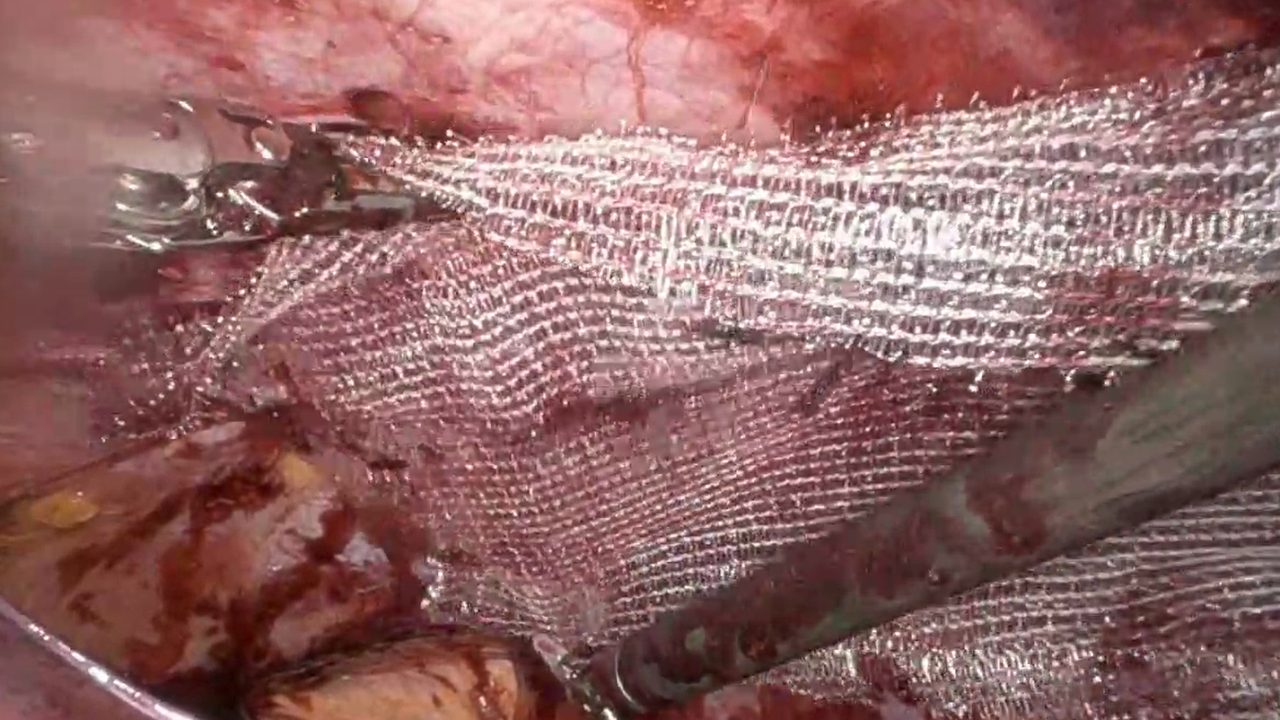
Mesh is used in most repairs, when safe and appropriate. Dr. Toomari works hard to keep the mesh out of the peritoneal cavity. When it is safe and appropriate, he uses a robotic preperitoneal (TAPP) repair, placing the mesh between the muscle and the peritoneum and closing the peritoneal flap over it. Some minimally invasive repairs instead place a coated mesh inside the abdominal cavity (IPOM). See TAPP vs IPOM: where the mesh goes and what to ask your surgeon.
Care with Dr. Toomari
Dr. Nojan Toomari, DO, FACS, is a board-certified general surgeon and Director of Robotic Surgery at Dignity Health – Northridge Hospital Medical Center, and President and Founder of LA Hernia Center (est. 2014). He has been in private practice in Encino since 2014 and has performed more than 2,200 robotic procedures. He offers open, laparoscopic and robot-assisted laparoscopic repair, and will explain which approach, if any, fits your hernia and your health. Not every hernia needs surgery right away.
Surgical images
These de-identified intraoperative stills are from Dr. Toomari’s robotic cases. They are educational, contain surgical views, and do not show every patient’s operation.
Surgical videos
These videos are from Dr. Toomari’s YouTube channel and contain surgical footage. They are educational and do not show every patient’s operation or result.
Questions patients often ask
Is robotic surgery performed by a robot on its own?
No. The surgeon is in the room and controls the instruments at all times. The platform translates the surgeon’s hand movements to small tools inside the body. It does not operate independently.
Is robotic repair right for every hernia?
No. Some hernias and some medical conditions are better served by an open or standard laparoscopic operation, or by no surgery at all. Dr. Toomari also notes that some patients who cannot have standard laparoscopy may still be candidates for a robotic approach, after a thorough exam.
What platform is used?
Robot-assisted cases in this practice are performed on the da Vinci platform (Intuitive), when that approach is appropriate.
Related pages
What patients have said about robotic care
Excerpts from public patient reviews on Google. Individual experiences vary; these are not a guarantee of results. Read reviews on Google.
Dr. Toomari performed a robotic hiatal hernia surgery on me 2-1/2 weeks ago. … Dr. Toomari took the time to answer my questions before the surgery and after the surgery. He is caring and understanding. His staff is quick to respond.
It starts with his staff in Encino. Kimya set up my appointment, she's knowledgeable, patient and efficient . Answering all my questions. I had Robotic bilateral inguinal and femoral hernia to repair.
Experience by the numbers
More than 2,200 robotic procedures have been logged under Dr. Toomari’s surgeon ID since 2016. The figures below are case counts and console times from those records, plus one older personal series. They are not a measure of outcomes for any one patient.
Hernia case volume by type
| Hernia type (Intuitive portal category) | Device-logged cases, all-time |
|---|---|
| Bilateral inguinal hernia repair (TAPP) | 580 |
| Unilateral inguinal hernia repair (TAPP) | 416 |
| Abdominal wall hernias (ventral hernia repair (TAPP) 211; incisional hernia repair (TAPP) 79; umbilical hernia repair 50) | 340 |
| Inguinal and abdominal wall hernias above (excluding hiatal) | 1,336 |
| Hiatal hernia repair (listed separately in the same portal) | 75 |
| All robotic-assisted procedures, including non-hernia cases | 2,224 |
The 2,224 all-procedure total is the source for the site wording “more than 2,200 robotic procedures.” It includes non-hernia robotic operations logged under the same surgeon ID, such as cholecystectomy. Procedure categories are Intuitive’s. These counts are not a prediction of any one patient’s result.
Console time compared with Intuitive U.S. figures
Console time only, not total operating time. These figures are minutes at the surgeon console. They are not incision-to-close time, not anesthesia time, and not a measure of outcomes. Benchmarks and case-volume buckets are Intuitive’s.
- His average console time
- Intuitive U.S. average
- Intuitive U.S. top 10%
| Procedure | His case-volume bucket | His average console time (min) | Intuitive U.S. average (min) | Intuitive U.S. top 10% (min) |
|---|---|---|---|---|
| Cholecystectomy | 101+ cases | 19 | 31 | 20 |
| Bilateral inguinal hernia repair | 101+ cases | 33 | 47 | 30 |
| Unilateral inguinal hernia repair | 101+ cases | 37 | 46 | 29 |
| Ventral hernia repair (TAPP) | 101+ cases | 53 | 64 | 36 |
| Hiatal hernia repair | 51–100 cases | 49 | 103 | 53 |
| Incisional hernia repair | 51–100 cases | 64 | 78 | 37 |
| Umbilical hernia repair | 26–50 cases | 46 | 55 | 28 |
Laparoscopic TEP compared with robotic TAPP (inguinal)
In a single-surgeon, non-randomized internal review (2016–2019; pain on a 0–10 scale), Dr. Toomari compared laparoscopic totally extraperitoneal (TEP) repair with robotic transabdominal preperitoneal (TAPP) repair for inguinal hernias and reported the pain and narcotic-use figures below. The review has not been independently audited. It is not a prediction of any one patient’s result.
| Measure | Laparoscopic TEP | Robotic TAPP | Reported p-value |
|---|---|---|---|
| Pain score, postoperative day 3 | 6.5 | 2.75 | 0.012 |
| Pain score, postoperative day 7 | 5 | 1.2 | 0.002 |
| Narcotic use (units as recorded on the original slide) | 15.5 | 3.9 | 0.027 |
In that review, 60% of robotic TAPP patients used no narcotics. Narcotic-use units are as recorded on the original slide.
Case counts and console times from Dr. Toomari’s Intuitive da Vinci system records (device-logged, all-time through Nov 2026); not independently audited. Console time is not a measure of outcomes.
Talk with our office about your hernia
The quickest way to request a consultation is to call. Our staff can explain next steps and what to bring.