Diastasis recti
Diastasis recti in men
Diastasis recti is not only a pregnancy condition. Men develop it too, often alongside an umbilical or epigastric hernia. Dr. Toomari evaluates both and explains what is a separation, what is a hernia and what is neither.
- Diastasis recti in men
- Abdominal fat and weight changes
- Weightlifting and straining
- Prior abdominal surgery
- Often found with umbilical or epigastric hernia
- Diastasis, hernia or a simple bulge?
- Non-surgical options
- Dr. Toomari’s robotic approach
- Before and after photos
- Insurance
- Recovery: typical ranges
- Care with Dr. Toomari
- References
- Questions patients often ask
- Related pages
Diastasis recti in men
Diastasis recti is a separation of the two rectus (“six-pack”) muscles along the midline of the abdomen. The band of tissue between them, the linea alba, is stretched and thinned rather than torn open, so it is not a true hernia. In men it usually develops gradually, when the midline is under steady pressure from inside the abdomen or from repeated strain.
Read the diastasis recti overview for how diastasis differs from a hernia in general.
Abdominal fat and weight changes
Fat stored inside the abdomen, around the organs (visceral fat), raises pressure against the abdominal wall and is thought to be one of the main reasons men develop diastasis. Weight gain and later weight loss can also leave the midline stretched. Some men are asked to reach a body mass index (BMI) under 30 before surgery.
Weightlifting and straining
Heavy lifting with breath-holding, a chronic cough, or straining with constipation or urination all push outward on the midline. These are thought to contribute to diastasis and to hernias. Many men can stay active, but a movement that causes bulging or doming along the middle of the abdomen should be stopped or modified, and a new bulge or pain should be checked. After a repair, follow our 8-week safe exercise guide before returning to weight training.
Prior abdominal surgery
An earlier operation through the midline can leave the abdominal wall weaker along the incision. A widened midline and an incisional hernia can be present together after surgery, and an exam, sometimes with imaging, helps sort out which is which.
Often found with umbilical or epigastric hernia
In men, diastasis is often discovered because of a hernia. An umbilical hernia at the navel or an epigastric hernia in the upper midline, between the breastbone and the navel, can sit within a stretched midline. More than one small defect can be present.
When an umbilical or ventral hernia sits within a significant diastasis, repairing only the small hernia leaves the surrounding midline stretched. In that situation, repairing the hernia and bringing the separated muscles back toward the midline in the same operation may be discussed. Not everyone with both conditions needs this, and the plan is individual.
Diastasis, hernia or a simple bulge?
Not every rounded or protruding belly is a diastasis or a hernia:
- Diastasis recti. A ridge or coning along the midline when you sit up or do a crunch, with the muscles parted on either side.
- Hernia. A soft bulge, often at the navel or in the upper midline, that may grow when you stand, cough or strain and may flatten when you lie down. It can be tender.
- Abdominal fat. A firm, evenly rounded belly is often caused by fat inside the abdomen pushing the whole wall forward. The muscles may be close together, and surgery on the abdominal wall does not remove this fat.
Dr. Toomari can usually assess the separation in the office and, when needed, use imaging such as a CT scan to look for a hernia and plan treatment.
When a hernia is an emergency
Call 911 or go to the nearest emergency department if a hernia bulge becomes suddenly painful, firm, red or dark, or cannot be pushed back in, especially with nausea, vomiting, fever, or trouble passing gas or stool. These can be signs that the hernia is trapped and its blood supply is at risk.
Learn the difference between a reducible and an incarcerated hernia and what hernia strangulation means.
Non-surgical options
Not everyone with diastasis recti needs an operation. Physical therapy, core retraining and activity changes are reasonable first steps for many people, especially when there is no hernia and the separation is modest. Our diastasis recti core exercise guide lists gentle exercises, with reps and holds. Exercise does not close a true hernia.
Dr. Toomari’s robotic approach
When surgery is appropriate, Dr. Toomari uses a robotic, minimally invasive approach. When it is safe for your anatomy, he works in the preperitoneal plane, the same TAPP-style approach he uses for ventral and umbilical hernias: the hernia is repaired, the separated midline is brought back together with sutures, and mesh is placed between the muscle and the peritoneum, with the peritoneal flap closed over it so the mesh stays out of the abdominal cavity.
See TAPP vs IPOM: where the mesh goes for a diagram. Open repair is sometimes the better fit, and Dr. Toomari will explain why if so.
Before and after photos
These photos show men Dr. Toomari treated with robotic surgery for diastasis recti, in some cases with an umbilical hernia, before surgery and at a follow-up visit. They are cropped to the abdomen so no patient can be identified.
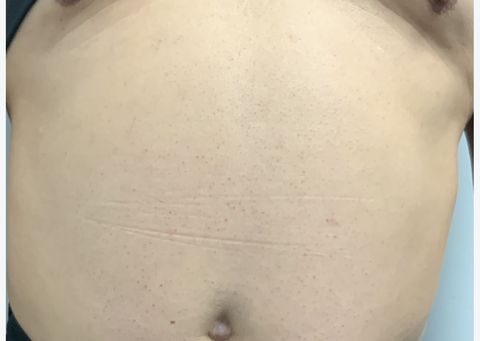
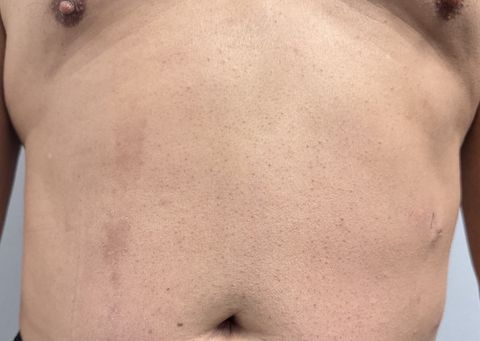
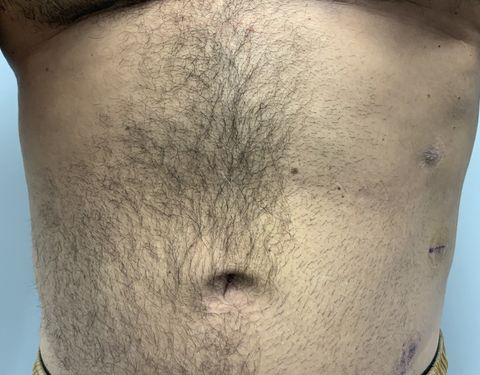
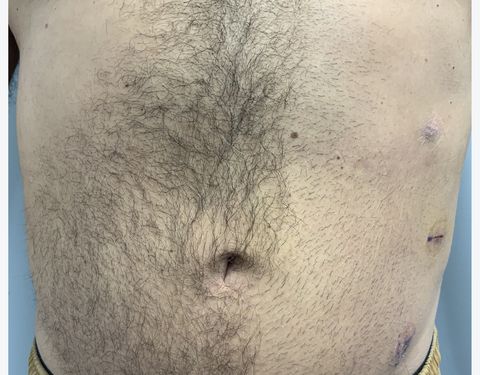
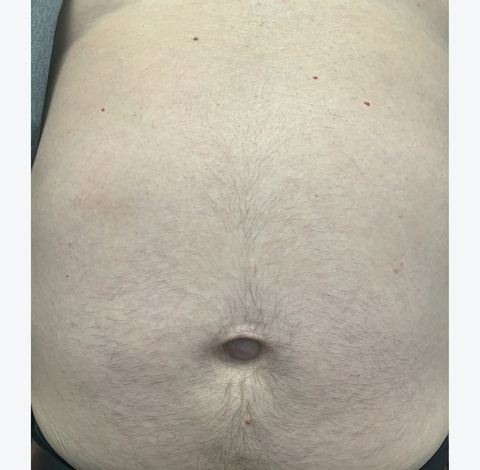
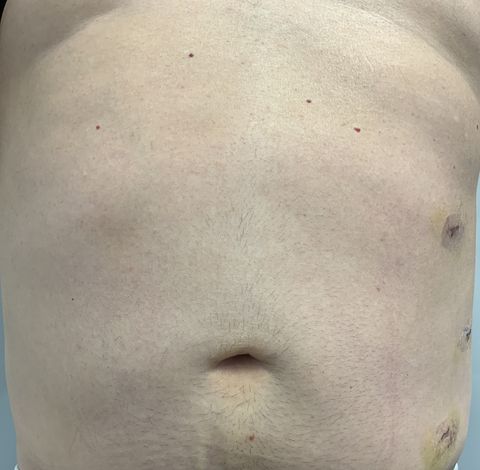
Photos shared with patient permission. Individual results vary.
Insurance
Insurance often doesn't cover diastasis repair. It can depend on your plan and on whether a hernia or another medical problem is present. Please call the office at (818) 570-1845 to talk about coverage before you schedule surgery.
Recovery: typical ranges
After a minimally invasive repair, many people walk the same day and return to light activity over one to two weeks. Heavy lifting and core strain, including weight training, are typically limited for 8 weeks (no lifting over 10 lb). Your surgeon will give you instructions for your repair. See exercise and core activity after repair.
These are typical ranges only. Recovery varies with the hernia, the type of repair, your health and the work or activity you return to. They are not a promise of how you will feel or when you can return to a specific activity. Dr. Toomari will advise you on walking, lifting, driving and follow-up for your situation.
Care with Dr. Toomari
Dr. Toomari evaluates diastasis recti and abdominal wall hernias at our Encino office for men across the San Fernando Valley and Los Angeles.
Dr. Nojan Toomari, DO, FACS, is a board-certified general surgeon and Director of Robotic Surgery at Dignity Health – Northridge Hospital Medical Center, and President and Founder of LA Hernia Center (est. 2014). He has been in private practice in Encino since 2014 and has performed more than 2,200 robotic procedures. He offers open, laparoscopic and robot-assisted laparoscopic repair, and will explain which approach, if any, fits your hernia and your health. Not every hernia needs surgery right away.
References
- Hernández-Granados P, Henriksen NA, Berrevoet F, et al. European Hernia Society guidelines on management of rectus diastasis. British Journal of Surgery. 2021;108:1189–1191. Accessed November 19, 2026.
This guideline informs the general information on this page. It is not a substitute for an individual evaluation.
Questions patients often ask
Can men get diastasis recti?
Yes. Diastasis recti is common after pregnancy, but it also occurs in men, often with extra weight around the abdomen, repeated straining or prior abdominal surgery. A hernia, usually at the navel or in the upper midline, is often found at the same time.
Is my belly bulge diastasis, a hernia or just fat?
It can be any of these, or a mix. Diastasis is a widened midline, a hernia is an opening in the abdominal wall, and a large, firm belly is often caused by fat inside the abdomen pushing outward. An exam, and when needed a CT scan, tells them apart.
Will repairing my diastasis flatten my stomach?
Not necessarily. Repair brings the separated muscles back toward the midline and fixes a hernia when one is present. It does not remove fat inside the abdomen or loose skin, so if most of the fullness comes from fat, the change in shape may be limited.
Can I keep lifting weights with diastasis recti?
Many men can stay active, but heavy lifting with breath-holding and straining puts pressure on the midline. Stop or modify a movement that causes bulging or doming along the middle of your abdomen, and have a new bulge or pain checked.
How long is lifting limited after repair?
Heavy lifting and core strain are typically limited for 8 weeks (no lifting over 10 lb) after diastasis repair with a hernia repair. Your surgeon will give you instructions for your repair, including when you can return to the gym.
Related pages
Talk with our office about your hernia
The quickest way to request a consultation is to call. Our staff can explain next steps and what to bring.