Education
What is a hernia?
A hernia is a bulge that occurs when tissue pushes through a weak area of the abdominal wall or groin. This page is general education, not a personal plan.
Definition
A hernia is a bulge that occurs when tissue — often fat or a loop of intestine — pushes through a weak area in the abdominal wall or groin. The bulge may be more noticeable when you stand, cough or strain, and it may be softer when you lie down. Some hernias cause pain or pressure; others are found during an exam for something else.
Anatomy
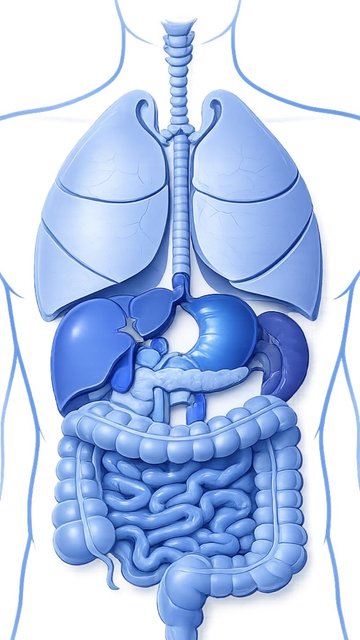
The abdominal wall is a layered structure of muscle and connective tissue that surrounds and supports the abdominal organs. Natural openings and prior incisions are potential weak points. When tissue pushes through one of those areas, a hernia can form.
This illustration is a general overview of the torso. It is not a picture of any one patient’s anatomy, and it is not a diagnosis.
Types
Hernias are named for where they occur. Pages on this site describe the types Dr. Toomari evaluates in Encino:
- Inguinal hernia — the most common groin hernia, on one or both sides, in men and in women.
- Femoral hernia — a less common groin hernia that appears in the upper inner thigh, just below the groin crease.
- Umbilical hernia — a bulge at or near the belly button.
- Epigastric hernia — a bulge in the midline of the upper abdomen, between the breastbone and the navel.
- Ventral hernia — a broader term for a hernia through the front of the abdominal wall, including umbilical, epigastric and incisional hernias.
- Incisional hernia — a hernia at the site of a previous abdominal operation.
- Recurrent hernia — a hernia that returns after a prior repair.
Diastasis recti is a separation of the two rectus (“six-pack”) muscles along the midline. The midline tissue is stretched rather than torn open, so it is not a true hernia, though a hernia can be present at the same time.
Symptoms
The usual sign is a bulge that may enlarge with coughing, standing or strain. Some people feel pain, pressure or a sense of heaviness. Sudden severe pain, a bulge that becomes firm, tender or discolored, or nausea and vomiting are reasons to seek emergency care — see hernia symptoms.
Causes
Some people are born with a weakness in the abdominal wall or groin. Others develop a hernia over time with strain, aging, pregnancy, weight changes or prior surgery. An incisional hernia can form at a previous incision. Hernias also occur without an obvious cause. More detail is on hernia causes and risk factors.
Treatment
Not every hernia needs surgery right away. The decision is usually between watchful waiting and planned repair, made after an exam. When repair is appropriate, Dr. Toomari offers open, laparoscopic and robot-assisted laparoscopic approaches, and will explain which option, if any, fits your hernia and your health. Mesh may be part of the plan for many repairs; see hernia mesh.
A truss or belt does not repair a hernia. In adults, a hernia does not typically heal by itself — with an important exception for some infant umbilical hernias, described on Can a hernia heal without surgery?
Dr. Nojan Toomari, DO, FACS, is a board-certified general surgeon and Director of Robotic Surgery at Dignity Health – Northridge Hospital Medical Center, and President and Founder of LA Hernia Center (est. 2014). He has been in private practice in Encino since 2014 and has performed more than 2,200 robotic procedures. He offers open, laparoscopic and robot-assisted laparoscopic repair, and will explain which approach, if any, fits your hernia and your health. Not every hernia needs surgery right away.
Questions patients often ask
What is a hernia, in simple terms?
A hernia is a bulge that occurs when tissue — often fat or a loop of intestine — pushes through a weak area in the abdominal wall or groin.
Do all hernias need surgery?
No. Not every hernia needs surgery right away. Some can be watched after a careful exam. Dr. Toomari will discuss the options that fit your hernia and your health.
What types of hernias does this practice treat?
This site covers abdominal wall and groin hernias, including inguinal, femoral, umbilical, epigastric, ventral, incisional and recurrent hernias, as well as diastasis recti (which is not a true hernia) and abdominal wall reconstruction when that is appropriate.
Related pages
Talk with our office about your hernia
The quickest way to request a consultation is to call. Our staff can explain next steps and what to bring.